
Hey, welcome to Alternatievemiddelen.nl by Tom & Melanie

Fast delivery

Free delivery on orders of €75 or more (NL) and €100 or more (in BE and DE)

Collection available

Sarati EMP Essential Moisture Plus Cream

EMP Essential Moisture Plus Cream – Used for vaginal irritation and itching, vaginal dryness, and discomfort or pain during sexual intercourse.

EMP Essential Moisture Plus Cream
select...

  • Delete
  • Delete
  • Delete
  • Delete
  • Delete
  • Delete
  • Delete
  • Delete
  • Delete
  • Delete
  • Delete
  • Delete
  • Delete
  • Delete
  • Delete
  • Delete
  • Delete
  • Delete
  • Delete
  • Delete
  • Delete
  • Delete
  • Delete
  • Delete
  • Delete
  • Delete
  • Delete
  • Delete
  • Delete
  • Delete
  • Delete
  • Delete
  • Delete
  • Delete
  • Delete
  • Delete
  • Delete
  • Delete
  • Delete
select...

  • Delete
  • Delete
  • Delete
  • Delete
  • Delete
  • Delete
  • Delete
  • Delete
  • Delete
select...

  • Delete
  • Delete
  • Delete
  • Delete
  • Delete
  • Delete
  • Delete
  • Delete
  • Delete
  • Delete
  • Delete
  • Delete
  • Delete
  • Delete
  • Delete
  • Delete
  • Delete
  • Delete
  • Delete
  • Delete
  • Delete
  • Delete
  • Delete
  • Delete
  • Delete
  • Delete
  • Delete
  • Delete
  • Delete
  • Delete
  • Delete
  • Delete
  • Delete
  • Delete
  • Delete
  • Delete
  • Delete
  • Delete
  • Delete
select...

  • Delete
  • Delete
  • Delete
  • Delete
  • Delete
  • Delete
  • Delete
  • Delete
  • Delete

Frequently asked questions about Berkey water filters

Find the answers to frequently asked questions about Berkey products here. These are updated from time to time. All answers are based on information from the manufacturer’s knowledge base, supplemented by our own experience.

The Environmental Working Group (EWG) has tested 10 water filtration systems for their ability to remove 25 individual per- and polyfluoroalkyl substances (better known as "PFAS") from tap water. During the EWG’s tests, the Berkey water filter (fitted with Black Berkey filter cartridges) removed PFAS to undetectable levels, resulting in the system being placed in the "Best overall" category.

The Berkey water filter was also praised for its large capacity compared with other water filters tested, and its “exceptionally long filter life” (each pair of genuine Black Berkey filter elements can filter up to approximately 22,700 litres (11,350 litres each) of tap water before replacement is recommended). CBS News Philadelphia produced a news report on the EWG’s tests, in which the Berkey water filter is mentioned. You can view this here. CBS Colorado also mentioned the Berkey water filter in a TV news report on the EWG test, You can view it here.

The EWG’s water filter test results were published a week after the United States Geological Survey (USGS) their studies published a study showing that the drinking water of nearly half of American households contains at least one type of PFAS. PFAS have been in use since at least the 1950s and have been linked to a wide range of health problems in humans, including certain types of cancer and developmental, metabolic and immune disorders, amongst others. PFAS are known as "forever chemicals" because they take a very long time to break down in the environment.

To protect yourself against PFAS in your drinking water, you need to ensure you have a final barrier system in place. This could be a Berkey water filter fitted with the powerful Black Berkey filter elements, which have been independently tested by accredited laboratories to remove perfluorinated chemicals to below detectable levels.

Read more:
- EWG: Press Release | Guide to PFAS Water Filters
- CBS Colorado: Which Water Filters Can Block PFAs
- CBS News Philadelphia: Environmental Group Tests to Find the Best Water Filters for Removing PFAS
- New Study: “Forever Chemicals” Found in Nearly Half of US Tap Water
- Do Black Berkey® Elements Remove PFAS and Other PFCs from Drinking Water?
- Black Berkey® Elements: The Final Barrier against PFOA and Other PFCs in Drinking Water
For all laboratory test results for the Berkey water filter: click here. You will be redirected to the manufacturer’s knowledge base, where all the results are listed on a single page. These are the results of all the tests carried out using the Black Berkey filter cartridges, which are the filter cartridges for the Berkey water filter.

This page also includes the test report for the Berkey Fluoride & Arsenic (PF-2) filter cartridges.

The top chamber of your Berkey water filter should have drained completely in about 2 hours (a small layer will remain). The more successful the priming, the faster the flow rate will be. So, if it takes longer than 2 hours, we recommend priming again. If this is your first time, the priming process is unlikely to have been successful and there is still too much air trapped in the Black Berkey filter elements. If you have been using the system for some time, this is a sign that you need to prime it again.

Priming ensures that the air is expelled from the filters, which then allows them to flow through more quickly again. You can do this by using the Priming Button, the Black Berkey Primer or the Blue Primer Rite use. See also the instructional videos.

Is this the first time you’ve used the Berkey water filter? If so, the following is just as important:
- The filter rate will increase slightly over the first 12 to 24 hours.

If the flow rate remains low and there is therefore still water left in the upper tank after well over 2 hours, then contact Get in touch with us and we’ll be happy to help you.

It is quite normal for a few centimetres of water to remain in the top chamber. This is because the Black Berkey filter cartridges sit on a rim, and naturally, water cannot pass over this rim. Furthermore, the water pressure is very low when there is only a small amount of water left in the upper chamber, which means the water can no longer flow through. This applies when the water level is still just slightly above the rim of the filter cartridge.

You can, if you wish, pour away any remaining water when you refill the top chamber of your Berkey water filter.

This is possible! No two Black Berkey filter elements are the same; they are all unique. As a result, one filter element may be used up more quickly than another. These differences arise during production (the baking process) and you’ll often find that the filters in the same box are roughly the same, but this isn’t necessarily the case. So it’s not a problem and nothing to worry about.

If you notice a significant difference in the filtration rate of the Black Berkey filters, this is a sign that it’s time to prime them again. Before you start cleaning, you should first try to resolve this by priming the Black Berkey filter elements again. You shouldn’t clean them too often; when using tap water, once every six months is sufficient. If priming does not improve the filtration rate, then it is time to clean the filters. However, you must prime them again after cleaning.

Priming ensures that the air is expelled from the filters, which then allows them to flow through more quickly again. After a while’s use, the air gradually builds up in the filters again. You can do this by Priming Button, the Black Berkey Primer or the Blue Primer Rite use. See also the instructional videos.

If you do need to clean the filters, please refer to the instructions under the heading "Cleaning, maintenance and storage".

This is known as an ‘airlock’. In this case, the containers fit together so perfectly that no air can get in. It is difficult to predict in advance when this might happen, as sometimes they fit together too perfectly.

There are two ways to solve this problem:

Option 1. Make use of the Anti-Airlock Clip. If you ordered a Berkey water filter from the summer of 2022 onwards, you will already have received it. This clip is included in the Priming Starter Kit, which has been supplied free of charge with a Berkey water filter since the summer of 2022. If you do not have the Priming Starter Kit, you can order the Anti-Airlock Clip separately from us, click here.
Place the clip on the rim of the bottom container, with the rounded side facing outwards. Then put the top container back on. This will allow sufficient air to get in, so a vacuum will no longer form and the water will drain out properly.

Option 2. You could also try rotating the top tray into different positions to see if this improves the fit and allows air to circulate. Another solution is to 'roll' the bottom tray:
- Carefully remove any Black Berkey filter cartridges from the system and set the top container aside.
- If it is already fitted, remove the tap from the lower container.
- Place a towel on a smooth, hard surface. Place the bottom container on its side on the towel, making sure the towel is held firmly in place.
- Using both hands, apply gentle pressure to the side of the lower chamber; roll the chamber back and forth across the hard surface. Focus your attention on the upper part of the lower chamber. This will reshape the lower chamber slightly and allow for good airflow between the upper and lower chambers.

If you decide to use the dice, it may be that the problem isn’t solved after just one go, but in that case you could always have another go.

The fluoride and arsenic filters (PF-2) last for up to 3,700 litres of water or one year, whichever comes first. Of course, it is very difficult to keep track of the number of litres, which is why we recommend sticking to one year.

The filter’s service life varies depending on the source water and the level of contamination. The recommendation for when the filter should be replaced depends on various factors. For filtering chlorine, for example, the filters last for more than 45,000 litres per pair. However, there are several contaminants in the water and the amount present can vary.

The Black Berkey filters have therefore been designed to last for many years. However, we are now living in a different era to that of a few years ago. The number of contaminants has only increased, and they have become increasingly severe (think, for example, of PFAS or the significant rise in pharmaceutical residues, pesticides, etc.). This has a huge impact on the filters, meaning they need to be replaced a little sooner. It is, of course, difficult to keep track of exactly what is in the water and in what quantities, which is why we recommend replacing Black Berkey filters every three years at most when using tap water. If you use water from another source, we advise replacing them sooner.

It is worth noting that a Berkey water filter does not completely remove limescale from the water. Larger amounts are reduced and synthetic limescale is removed. However, a Berkey water filter retains beneficial minerals (those that occur naturally in water and are good for human health) in the water. And calcium is one of these. So you retain the mineral calcium in the water, and this can still cause some limescale build-up. In short, a Berkey water filter is not designed to remove limescale from the water.

If water is leaking from the tap’s connection, this is most likely because the tap has not been fitted correctly. So empty the bottom tray and take the tap apart. Then check that all the parts are in the correct position. It’s important to ensure you have one rubber O-ring on the outside and one on the inside. Next, put the tap back in place and tighten the nut (on the inside) as far as it will go. Then hold the nut on the inside in place and turn the tap on the outside. You’ll notice that it becomes even tighter. Carry on doing this until you can’t tighten it any further. If the tap isn’t straight, do the following: loosen the nut on the inside and turn only the tap on the outside until it’s straight. This is because the whole unit rotates as one. If you’ve accidentally turned it too far, DO NOT turn it back. Doing so will simply loosen it again. So, if you’ve gone too far, simply turn the whole thing through again until it’s sitting properly.
If all goes well, the tap shouldn’t be leaking at the connection any more.

If water gets between the top and bottom chambers of your Berkey water filter, it means that the bottom chamber is too full. This happens when the top chamber is refilled whilst the bottom chamber is not yet empty. In this case, the water simply continues to be filtered, causing the lower chamber to overflow. The water then leaks out between the two chambers.
It’s best to fill the top tank completely the first time you fill it. Let this water run through. If you notice that the lower tank is almost empty (as indicated by the sight glass tap or the water pressure), then fill the upper tank right up to the top again. You can do this because the upper tank is slightly smaller than the lower tank and, in addition, the upper tank contains the filters, which take up space. The lower tank therefore has excess capacity compared to the upper tank. By doing it this way, you prevent water from leaking between the two tanks.

IMPORTANT INFORMATION BEFORE YOU BEGIN
The red food colouring test is solely intended to check that your Berkey water filter has been assembled correctly – in other words, to ensure that no water is coming from anywhere other than the stems of the Black Berkey filter elements and that the filters are not worn out. Berkey Water Systems does not have any independent test results showing the percentage by which the red food colouring is filtered out. They cannot therefore officially claim that this contamination is reduced. Consequently, if the instructions below are not followed – for example, if a higher concentration of red food colouring is used – it is likely that it will not be reduced by 100% per cent. It is therefore important to follow the instructions below carefully; this mainly concerns the amount of red food colouring used and ensuring the test is not carried out more than twice a year.

The Black Berkey filter cartridges are powerful enough to remove red food colouring from water. By carrying out a red food colouring test, you can be sure that your Berkey water filter system is working properly.

GUIDELINES

  • We recommend carrying out this test the first time you use the system and then every six months (after cleaning) to ensure that the Black Berkey filter elements are working properly.
  • The red dye test is intended solely for use with Black Berkey filter cartridges and NOT for other filter elements (such as the Fluoride & Arsenic filters, for example) which do not filter out the colouring agent. This test is also not recommended for the Sport Berkey water bottle.
  • Make sure the colouring is RED. Red food colouring (unlike the other colours) does not contain any minerals, so the element recognises it as a contaminant. Furthermore, do not use natural red colouring (such as beetroot juice, for example), as this is not recognised as a contaminant either. The aim is to use a synthetic red food colouring, so please use the original red food colouring.
  • The red dye test must be carried out after the Black Berkey filter cartridges have been primed.

CARRYING OUT THE TEST

NOTE: Take a look at our iinstructional videos for a video showing how to carry out the red dye test.

1. Start with an empty water filter system (top and bottom tanks) and remove any fluoride filters (if fitted).
2. Place only the top container (with the Black Berkey filter elements installed) on glasses of a similar size (so that the filter stems protrude from the glass). This makes it easy to see straight away which filter passes and which fails the test.
3. In a separate jug, add 3 drops (= 0.15 ml) of food colouring per litre of water and mix (using a small bottle original red food colouring (so you can carry out a full test several times). Pour the red water into the top container until the filters are completely submerged. Please note: Never pour red food colouring straight from the bottle onto the filters or into the top compartment. Always mix the food colouring with water in a separate jug first.
4. Allow the water to filter from the top container into the glasses below. When the glasses are three-quarters full, pour the remaining water out of the top container. Please note: The glasses can be filled at different speeds.
5. Check the water in each glass. It should be clear, with no pink or red tinge. If the water in any of the glasses is red or has a pink tinge, that particular filter may be faulty or worn out. See below.

IF YOU NOTICE A RED COLOUR IN THE WATER, CHECK THE FOLLOWING:

1. Are the wing nuts securely fastened? Do not tighten the wing nuts with tools; they should be tightened by hand until you feel resistance – that is sufficient. If the wing nuts are overtightened, this may damage the thread on the stem and/or the grooves on the wing nut. This may affect the seal. Should this occur, please contact us.
2. Do you use natural red food colouring or a different colour of food colouring? No natural red food colouring is the only type recommended for this test.
3. Is the black ring from the Black Berkey filter elements also in the top chamber, and is the wing nut tightened at the bottom? If the black ring is on the outside of the bottom chamber (i.e. right next to the wing nut), this does not provide a proper seal. Consequently, the test will fail. Place the black ring on the inside of the upper chamber and repeat the test.
4. Do the plug caps seal the unused holes properly (where applicable)? Are the plug caps securely fitted so that the hole is actually sealed? For plug-caps with a bolt and nut, there must be a sealing ring on both sides (not just on one side). If the plug-caps are leaking, this will cause the test to fail. Tighten the plug-caps more securely and repeat the test.
5. Are you retesting a filter element that has failed? If so, make sure you rinse this filter element and prime it again before retesting. Also, make sure all the water has been drained from the bottom tray (or glass). If you are using the bottom tray or a glass to collect water, rinse it thoroughly with clean water first. You are now ready to repeat the test.
6. If you have done all of the above and a filter element still fails the red dye test, then contact Get in touch with us. The Black Berkey filter cartridges come with a two-year warranty (in instalments). Take a look at the warranty terms and conditions.

NOTE: Take a look at our instructional videos for a video showing how to carry out the red dye test.

The Black Berkey filters are made from a patented blend of various components, including, for example, high-quality carbonised coconut shell. Berkey Water Systems confirms that there is no graphene oxide in the composition of the filter elements.

Furthermore, Berkey Water Systems does not have any test reports available to verify the reduction of graphene oxide by the Black Berkey filters. Without test results, they cannot claim that the filter elements are capable of reducing or removing this contaminant.

There are three different types of blocking plugs:

  1. Black blocking plugs are supplied as standard with all Berkey Light water filters and some stainless steel models. The black plugs are made from FDA-approved Buna rubber.
  2. Off-white sealing plugs (rubber cork) are available for the Berkey Light models and some stainless steel models. The off-white plugs are made from food-grade M18 pure natural rubber.
  3. White locking plugs (bolt and nut) are used in some stainless steel models. These are supplied with a nut, a bolt and two transparent rings. The nut and bolt are made of polypropylene. The rings are made of food-grade silicone.

Please note that the water in the lower chamber of your water filter will not come into contact with any of the blocking plugs. This is because the water is filtered before it reaches the lower chamber.

Yes, the base of a Black Berkey filter cartridge is BPA-free.

The Black Berkey filter cartridges are designed to remove heavy metals, but will not remove the mineral salts added by a water softener. This is because a water softener adds mineral salts to the water to make it softer. The salt used to soften water is not extracted by a Black Berkey filter cartridge and will actually cause the cartridge to become blocked. You can still use a Berkey water filter if it is possible to bypass the water softener. Most water softeners have a bypass valve or a way to divert water before it passes through the softener. We therefore strongly recommend using that water instead of running softened water through your Black Berkey filter cartridges.

Black Berkey filter elements do not necessarily need to be cleaned every time you clean the housing of the Berkey water filter (the lower and upper chambers). However, this may vary depending on the region and water source. In certain parts of the world, the water is much dirtier than in others, and it will be necessary to clean the elements more frequently; possibly even more often than cleaning the rest of the system requires. If your water is muddy or very dirty, we recommend pre-filtering it by running it through a piece of fabric, e.g. a shirt, sheet, bandana, etc., before filling the Berkey water filter with it. Although this isn’t essential, it helps to reduce the frequency of filter element cleaning by trapping dirt that could block the pores of your Black Berkey filter elements.

When is it time to clean your filters?

  • The elements should be cleaned when you notice a significant reduction in the flow rate.
  • You may also wish to consider cleaning the elements periodically. For example, every 6 months (PLEASE NOTE!! Never more frequently than once every 6 months, unless you notice a reduction in flow rate). The advantage of this is that you will not experience a slow flow rate. Cleaning the elements on a regular schedule is at your own discretion. This is a suggestion, not an obligation.

How do you clean the filters?

  1. Empty your Berkey water filter and remove the Black Berkey filter cartridges.
  2. Use a scouring pad or a stiff brush and gently scrub the outside of the Black Berkey filter elements under cold running water.
  3. Refit the filters. If you’re not familiar with this process, please have a look at our instructional videos.
  4. Refit the Black Berkey filter cartridges into the Berkey water filter.
  5. Finally, fill your Berkey water filter and, if necessary, carry out a red dye test as described in the instructional videos, to ensure that the Black Berkey filter cartridges are still effective.

A TDS meter does not detect much difference between unfiltered water and water filtered using a Berkey filter. This is normal, and the reason has to do with what a TDS meter actually measures. According to tdsmeter.com, "Total Dissolved Solids (TDS) is the total amount of mobile charged ions, including minerals, salts or metals dissolved in a given volume of water, expressed in units of milligrams per unit volume of water (mg/L), also known as parts per million (ppm). TDS is directly related to the purity of water and the quality of water treatment systems, and affects everything that consumes, lives in or uses water – whether organic or inorganic – for better or for worse.”

This statement is both correct and incorrect. It is correct in terms of what a TDS measurement consists of, namely the “total amount of mobile charged ions, including minerals, salts or metals dissolved in a given volume of water”. It is incorrect in its conclusion that TDS is related to the purity of the water and the quality of the water purification system. If the measure of a water purification system were how close it could bring the water to pure H₂O, then it might be correct. But people need minerals to live. So beneficial minerals in your water are actually a good thing. A high-quality water purification system should filter out substances that are harmful to your body, whilst retaining the beneficial elements such as minerals. Black Berkey filter cartridges are designed to retain healthy and beneficial minerals in the water whilst removing unwanted heavy metals such as lead and mercury, as well as sedimentary minerals such as iron oxide and aluminium.

So, if you use a TDS meter, you will find that the reading is roughly the same both before and after the water has passed through the Black Berkey filter cartridges. And that is exactly right. The Black Berkey filter cartridges retain all the beneficial minerals. So, of the substances that a TDS meter will actually detect, the Black Berkey filter cartridges will only remove unwanted heavy metals such as lead and mercury, as well as sedimentary minerals such as iron oxide and aluminium. Therefore, the TDS reading will not change significantly, unless your water contains a substantial amount of heavy metals or sedimentary minerals.

A TDS meter does not measure the level of biological and chemical contaminants (including, for example, chemicals, medicines, hormones, many pesticides and their residues, bacteria and viruses). The most important thing is not to rely solely on a TDS meter to determine whether your water is safe. You can have water with a low TDS reading that still contains harmful bacteria. You can have water with a high TDS reading that is completely safe (e.g. pure, uncontaminated seawater… although you wouldn’t drink it, but that’s only because it’s mineral salt). So make sure you know what a TDS meter actually measures.

Once you’ve used your elements:

The method of storage depends on how long the Black Berkey filter cartridges are not in use:

If the filters are not used for 4 to 15 days and you wish to avoid having to prime them again, remove the filters from the water filter, place them in a sealable bag or container, and store them at the front of the fridge to prevent them from freezing. This ensures the filters remain largely saturated (wet), so that re-priming is usually not necessary. If, for any reason, the filters are working more slowly than usual, re-prime them until water droplets begin to form on the outer surface of the filter for 10 seconds.

For long-term storage, we recommend drying the filters and storing them in a sealed container. It is important that they are completely dry before being stored long-term, to prevent any bacterial growth. One way to dry your filters is to leave them on a windowsill for one to three days to air-dry. We also offer a tool to assist with both priming and purging. This is the Black Berkey Primer. The advantage of drying (purging) the Black Berkey filter elements using the Black Berkey Primer is that they dry very quickly. Once the filters are completely dry, place them in a storage bag, such as a large, sealable bag. The elements are extremely powerful and can absorb odours and smoke from the air. By sealing them in a bag, they cannot absorb odours from the air. When you are ready to use the filters again, clean them by scrubbing the outside with a scouring pad or a stiff brush. Then prime the filters again, either by hand or using the Black Berkey Primer, before putting them back into the water filter.

In theory, the Black Berkey filter elements have an unlimited service life.

**Please note that the storage methods listed above apply only to Black Berkey filter cartridges.

If you’ve never used the elements before:

If the cartridges are unopened and still in their original packaging, make sure you do not store them in a room with strong odours (such as a utility room or garage). As the elements contain carbon as one of their components, they may absorb odours from the room in which they are stored. For example, if they are kept in a laundry room, they may pick up the scent of strongly perfumed items such as washing powder.

** If you are also storing the upper and lower chambers of your Berkey system, it is best to empty both chambers before storing them. Water that stands for a long time encourages the growth and proliferation of bacteria. We recommend washing your Berkey system with soapy water before leaving it to dry.

If you’ve already used the elements:

The Berkey Fluoride & Arsenic filter elements (PF-2) can be stored in the fridge for a short time (see below); however, do not store them in the freezer under any circumstances. To do this, remove the filters from the water filter, place them in a sealable bag or container and position them at the front of the fridge to prevent them from freezing.

The Fluoride & Arsenic filter cartridges (PF-2) only last for one year. ‘Short-term’ therefore means: the next time they are used within that year. Bear in mind that the longer the cartridges are left unused, the more their ability to filter fluoride and arsenic may diminish. Furthermore, it is advisable to prime them every two weeks whilst they are in storage, to keep the storage process going.

If you have stored them in the fridge, we recommend that you prime the Berkey Fluoride & Arsenic filter cartridges (PF-2) again before using them. Do this for up to 1 minute in each direction.

The Berkey Fluoride & Arsenic filter cartridges (PF-2) must not be left to dry in the open air, as this may lead to some bacterial growth within the filters.

If you’ve never used the elements before:

If the batteries are unopened and still in their original packaging, make sure you do not store them in a room with a strong odour, such as a utility room or garage. As the elements contain carbon as one of their components, they may absorb odours from the room in which they are stored. For example, if they are kept in a laundry room, they may pick up the scent of strongly perfumed items such as washing powder.

Frequently Asked Questions: Boroux water filters

Yes, the stainless steel housing is essential for good performance. It supports the upflow design, which directs water from the bottom upwards, thereby reducing the flow rate and increasing the contact time between the water and the filter media. This optimised interaction improves fluoride reduction and overall effectiveness.

Yes, you need one BOROUX Proactive™ Fluoride filter for each BOROUX Foundation™ Black filter in your system. The BOROUX Proactive™ Fluoride filters are designed as a one-to-one product, which means that each fluoride filter connects directly to one BOROUX Foundation™ Black filter.

This ensures a balanced flow, good filtration performance and maximum fluoride reduction throughout your entire system.

Proudly made in the US! So not in China or any other Asian country.

The BOROUX Proactive™ Fluoride filter consists of two different layers. The inner layer is granulated carbon: small, loose granules of a mixture of different carbons are packed into the centre of the cylindrical filter. The outer layer of the filter is nanocarbon. This mixture of specialised carbon is moulded into shape.

The filter’s service life varies depending on the water source (the quality of the water going into it) and usage. It is recommended that filters be replaced after 3,750 litres, which is approximately 6–12 months.

No tests have yet been carried out for arsenic.

The first filtration stage takes place when the water passes through the proven BOROUX Foundation™ Black filters through activated carbon. The BOROUX Proactive™ Fluoride filter is screwed onto the shaft of the BOROUX Foundation™ Black filter and secured in place. The second stage of filtration takes place as the water flows through the dual-action BOROUX Proactive™ Fluoride filter.

After the water has passed through the filters in the upper chamber, it first comes into contact with the inner layer of the highly efficient granulated carbon filters in the lower chamber. The water then filters through the patented nano-carbon outer layer. Thanks to the patented Upflow design of the stainless steel housing, the water remains in contact with the outer layer for an extended period, ensuring superior filtration. The filtered water leaves the housing via the outlet holes at the top. This ensures that virtually the entire surface of the fluoride filters is utilised evenly, from bottom to top.

Yes, the BOROUX Proactive™ Fluoride filters are designed to be fully compatible with Berkey water filters. They are attached directly to the Black Berkey filters and therefore sit in the lower chamber, just like Berkey’s fluoride filters. This allows you to continue using your existing Berkey system whilst benefiting from BOROUX’s advanced fluoride-reducing technology. They will, of course, also fit into the housings of other brands’ gravity-fed water filters, provided that Black Berkey filters or BOROUX Foundation™ Black filters are used.

Do you need help checking compatibility? Please get in touch with us!

You may notice a subtle earthy or mineral-like taste when you first use your new BOROUX Proactive™ Fluoride filters. This is completely normal and temporary.

These filters use high-quality filter media which may initially impart a mild taste. To prevent or resolve this, we recommend priming each filter for at least 10 minutes using higher water pressure before installing them. It is also important to use warm water (around 38 °C). In tests, this method has resolved the taste issue in 100% of cases.

For the most effective priming, use the blue silicone primer supplied with the filters or the BOROUX Automatic Filter Primer Pump (electric). These help to rinse the filters thoroughly and ensure that your water tastes great right from the start.

Incorrect priming can lead to cloudy water, a lower flow rate, uneven filtration and a shorter filter life. The primer pump ensures consistent, correct priming for optimum filter performance.

On the contrary, using the Primer Pump results in a comprehensive and consistent priming guaranteed, which extends the service life of your filter and optimises its filtration performance.

Yes. The Primer Pump is compatible with Black Berkey filters and BOROUX Foundation™ Black and BOROUX Proactive Fluoride filters (adapter supplied with fluoride filters).

No, the Primer Pump is not waterproof. Do not completely submerge the Primer Pump in water.

The light on your primer pump gives you a quick indication of the current battery status. Here’s what each colour and the way the light flashes mean:

Solid green: fully charged and ready for use
Flashing green: charging
Flashing red: Battery level is below 25% – please charge soon
Steady red / no light / empty: Battery is almost flat – needs charging immediately

If you’re not sure whether the pump is working properly, we recommend that you charge it fully and check the indicator light again.

With a fully charged battery, you can use it for at least 10 filters prime it before you need to recharge the pump.
It takes about 90 seconds to fully prime a single filter.

The cap is made of high-quality stainless steel (304).

Yes, the BOROUX glass water bottle is dishwasher-safe, but the stainless-steel cap should only be washed by hand.

BOROUX glass water bottles can be reused repeatedly without any harmful chemicals leaching into the water. The cap is made of stainless steel both inside and out and features a silicone seal. With the BOROUX glass drinking bottle, you can enjoy the convenience of plastic without putting your health at risk.

Although borosilicate glass is resistant to temperature changes (as it does not expand in the same way as ordinary glass), we recommend using the BOROUX glass drinking bottles for cold drinks only.

Borosilicate glass has a wide range of applications. It is often used in cookware and laboratory equipment, but also in high-quality products such as optical lenses, implantable medical devices and aerospace equipment. It is also a popular material amongst artists, such as glass sculptors.

Although it is not completely unbreakable, it is more durable than ordinary glass. The base of the BOROUX glass drinking bottle is approximately 300% thicker than that of competing bottles to prevent breakage. If broken, borosilicate glass tends to shatter into large pieces rather than shatter into small fragments (it is more likely to break than to shatter).

Borosilicate glass is a higher-quality type of glass that is stronger, more durable and, above all, more resistant to cracking and thermal shock.

No, the Move Sleeve must only be hand-washed.

Absolutely! The sleeve is vacuum-insulated to keep drinks hot or cold for a long time.

You can BOROUX glass drinking bottle to use in your Move Sleeve to cold drinks Keep it cold for a long time. Keep the ice frozen all day.

Borosilicate glass is resistant to temperature fluctuations (as it does not expand in the same way as ordinary glass). We recommend only using the Move Sleeve for hotter liquids if you place the glass water bottle inside the Move Sleeve first before pouring the liquid in, as the glass will be very hot.

The white silicone ring is designed to be placed at the bottom of the Move Sleeve to stabilise the bottle. However, not all bottles require a ring; it is mainly there if the bottle sits a little loosely in the Move Sleeve. If you’re having problems with the thread at the top, try adjusting or removing the ring to see if that solves the problem.

No, the Move Sleeve is sold separately and is designed for the BOROUX 500ml glass drinking bottle.

IMPORTANT INFORMATION BEFORE YOU BEGIN
The red dye test is solely intended to check that your water filter has been fitted correctly – so that no water other than that from the stems of the BOROUX Foundation™ Black filter elements is coming through – and that the filters have not reached the end of their service life. There are no independent test results showing the percentage by which the red food colouring is filtered out. No official claim is therefore made that this contamination is reduced. If, therefore, the instructions below are not followed and, for example, a higher concentration of red food colouring or a different type of red food colouring is used, it is likely that it will not be reduced by 100% per cent. It is therefore important to follow the instructions below carefully; this mainly concerns the amount of red food colouring used and ensuring that the test is not carried out more than twice a year.

The BOROUX Foundation™ Black filter cartridges are powerful enough to remove red food colouring from water. By carrying out a red food colouring test, you can be sure that your water filter system is working properly.

GUIDELINES

  • We recommend carrying out this test the first time you use the product and then every six months (after cleaning) to ensure that the BOROUX Foundation™ Black filter elements are working properly.
  • The red dye test is intended solely for use with BOROUX Foundation™ Black filter elements and NOT for other filter elements (such as fluoride filters, for example) that do not filter out the colouring agent.
  • Make sure the colouring is RED. Red food colouring (unlike the other colours) does not contain any minerals, so the element recognises it as a contaminant. Furthermore, do not use natural red colouring (such as beetroot juice, for example), as this is not recognised as a contaminant either. The aim is to use a synthetic red food colouring, so please use the original red food colouring.
  • The red dye test must be carried out after the BOROUX Foundation™ Black filter elements have been primed.

CARRYING OUT THE TEST

NOTE: Take a look at our instructional videos for a video showing how to carry out the red dye test.

1. Start with an empty water filter system (top and bottom tanks) and remove any fluoride filters (if fitted).
2. Place only the top container (with the BOROUX Foundation™ Black filter elements installed) on glasses of a similar size (so that the filter stems protrude from the glass). This makes it easy to see straight away which filter passes and which fails the test.
3. In a separate jug, add 3 drops (= 0.15 ml) of food colouring per litre of water and mix (using a small bottle original red food colouring (so you can carry out a full test several times). Pour the red water into the top container until the filters are completely submerged. Please note: Never pour red food colouring straight from the bottle onto the filters or into the top compartment. Always mix the food colouring with water in a separate jug first.
4. Allow the water to filter from the top container into the glasses below. When the glasses are three-quarters full, pour the remaining water out of the top container. Please note: The glasses can be filled at different speeds.
5. Check the water in each glass. It should be clear, with no pink or red tinge. If the water in any of the glasses is red or has a pink tinge, that particular filter may be faulty or worn out. See below.

IF YOU NOTICE A RED COLOUR IN THE WATER, CHECK THE FOLLOWING:

1. Are the wing nuts securely fastened? Do not tighten the wing nuts with tools; they should be tightened by hand until you feel resistance – that is sufficient. If the wing nuts are overtightened, this may damage the thread on the stem and/or the grooves on the wing nut. This may affect the seal. Should this occur, please contact us.
2. Do you use natural red food colouring or a different colour of food colouring? No natural red food colouring is the only type recommended for this test.
3. Is the black ring from the BOROUX Foundation™ Black filter elements also in the upper housing, and is the wing nut tightened at the bottom? If the black ring is on the outside of the lower housing (i.e. directly next to the wing nut), this does not provide a proper seal. Consequently, the test will fail. Place the black ring on the inside of the upper housing and repeat the test.
4. Do the plug caps seal the unused holes properly (where applicable)? Are the plug caps securely fitted so that the hole is actually sealed? For plug-caps with a bolt and nut, there must be a sealing ring on both sides (not just on one side). If the plug-caps are leaking, this will cause the test to fail. Tighten the plug-caps more securely and repeat the test.
5. Are you retesting a filter element that has failed? If so, make sure you rinse this filter element and prime it again before retesting. Also, make sure all the water has been drained from the bottom tray (or glass). If you are using the bottom tray or a glass to collect water, rinse it thoroughly with clean water first. You are now ready to repeat the test.
6. If you have done all of the above and a filter element still fails the red dye test, then contact Get in touch with us. The BOROUX Foundation™ Black filter elements come with a one-year guarantee.

NOTE: Take a look at our iinstructional videos for a video showing how to carry out the red dye test.

Once you’ve used your elements:

The method of storage depends on how long the BOROUX Foundation™ Black filter elements are not in use:

If the filters are not used for 4 to 15 days and you wish to avoid having to prime them again, remove the filters from the water filter, place them in a sealable bag or container, and store them at the front of the fridge to prevent them from freezing. This ensures the filters remain largely saturated (wet), so that re-priming is usually not necessary. If, for any reason, the filters are working more slowly than usual, re-prime them until water droplets begin to form on the outer surface of the filter for 10 seconds.

For long-term storage, we recommend drying the filters and storing them in a sealed container. It is important that they are completely dry before being stored long-term, to prevent any bacterial growth. One way to dry your filters is to leave them on a windowsill for one to three days to air-dry. We also offer a tool to assist with both priming and purging. This is the BOROUX Automatic Filter Primer Pump (electric) or Black Berkey Primer. The advantage of drying (purging) the BOROUX Foundation™ Black filter elements is that they dry very quickly. Once the filters are completely dry, place them in a storage bag, such as a large, sealable bag. The elements are extremely powerful and can absorb odours and smoke from the air. By sealing them in a bag, they cannot absorb odours from the air. When you are ready to reuse the filters, clean them by scrubbing the outside with a scouring pad or a stiff brush. Then prime the filters again, either manually or using the BOROUX Automatic Filter Primer Pump (electric) or the Black Berkey Primer, before putting them back into the water filter.

In theory, the service life of the BOROUX Foundation™ Black filter elements is unlimited.

**Please note that the storage methods listed above apply only to BOROUX Foundation™ Black filter elements.

If you’ve never used the elements before:

If the cartridges are unopened and still in their original packaging, make sure you do not store them in a room with strong odours (such as a utility room or garage). As the elements contain carbon as one of their components, they may absorb odours from the room in which they are stored. For example, if they are kept in a laundry room, they may pick up the scent of strongly perfumed items such as washing powder.

** If you are also storing the top and bottom containers of your water filter, it is best to empty both containers before storing them. Water that stands for a long time encourages the growth and proliferation of bacteria and mould. We recommend washing your water filter with soapy water before leaving it to dry.

A TDS meter does not detect much difference between unfiltered water and water filtered using a BOROUX. This is normal, and the reason has to do with what a TDS meter actually measures. According to tdsmeter.com, "Total Dissolved Solids (TDS) is the total amount of mobile charged ions, including minerals, salts or metals dissolved in a given volume of water, expressed in units of milligrams per unit volume of water (mg/L), also known as parts per million (ppm). TDS is directly related to the purity of water and the quality of water treatment systems, and affects everything that consumes, lives in or uses water – whether organic or inorganic – for better or for worse.”

This statement is both correct and incorrect. It is correct in terms of what a TDS measurement consists of, namely the “total amount of mobile charged ions, including minerals, salts or metals dissolved in a given volume of water”. It is incorrect in its conclusion that TDS is related to the purity of the water and the quality of the water purification system. If the measure of a water purification system were how close it could bring the water to pure H₂O, then it might be correct. But people need minerals to live. So beneficial minerals in your water are actually a good thing. A high-quality water purification system should filter out substances that are harmful to your body, whilst retaining the beneficial elements such as minerals. BOROUX Foundation™ Black filter cartridges are designed to retain healthy and beneficial minerals in the water whilst removing unwanted heavy metals such as lead and mercury, as well as sedimentary minerals such as iron oxide and aluminium.

So, if you use a TDS meter, you will find that the reading is roughly the same both before and after the water has passed through the BOROUX Foundation™ Black filter elements. And that is exactly right. The BOROUX Foundation™ Black filter elements retain all the beneficial minerals. So, of the substances that a TDS meter will actually detect, the BOROUX Foundation™ Black filter elements will only remove unwanted heavy metals such as lead and mercury, as well as sedimentary minerals such as iron oxide and aluminium. Therefore, the TDS reading will not change significantly, unless there is a substantial amount of heavy metals or sedimentary minerals in your water.

A TDS meter does not measure the level of biological and chemical contaminants (including, for example, chemicals, medicines, hormones, many pesticides and their residues, bacteria and viruses). The most important thing is not to rely solely on a TDS meter to determine whether your water is safe. You can have water with a low TDS reading that still contains harmful bacteria. You can have water with a high TDS reading that is completely safe (e.g. pure, uncontaminated seawater… although you wouldn’t drink it, but that’s only because it’s mineral salt). So make sure you know what a TDS meter actually measures.

The BOROUX Foundation™ Black filter cartridges are designed to remove heavy metals, but will not remove the mineral salts added by a water softener. This is because a water softener adds mineral salts to the water to make it softer. The salt used to soften water is not extracted by a BOROUX Foundation™ Black filter cartridge and will actually cause the cartridge to become blocked. You can still use a BOROUX water filter if it is possible to bypass the water softener. Most water softeners have a bypass valve or a way to divert water before it passes through the softener. We therefore strongly recommend using that water instead of running softened water through your BOROUX Foundation™ Black filter cartridges.

If water gets between the upper and lower chambers of your BOROUX water filter, it means that the lower chamber is too full. This happens when the upper chamber is refilled whilst the lower chamber is not yet empty. In this case, the water simply continues to be filtered, causing the lower chamber to overflow. The water then leaks out between the two chambers.
It’s best to fill the top tank completely the first time you fill it. Let this water run through. If you notice that the lower tank is almost empty (as indicated by the sight glass tap or the water pressure), then fill the upper tank right up to the top again. You can do this because the upper tank is slightly smaller than the lower tank and, in addition, the upper tank contains the filters, which take up space. The lower tank therefore has excess capacity compared to the upper tank. By doing it this way, you prevent water from leaking between the two tanks.

If water is leaking from the tap’s connection, this is most likely because the tap has not been fitted correctly. So empty the bottom tray and take the tap apart. Then check that all the parts are in the correct position. It’s important to ensure you have one rubber O-ring on the outside and one on the inside. Next, put the tap back in place and tighten the nut (on the inside) as far as it will go. Then hold the nut on the inside in place and turn the tap on the outside. You’ll notice that it becomes even tighter. Carry on doing this until you can’t tighten it any further. If the tap isn’t straight, do the following: loosen the nut on the inside and turn only the tap on the outside until it’s straight. This is because the whole unit rotates as one. If you’ve accidentally turned it too far, DO NOT turn it back. Doing so will simply loosen it again. So, if you’ve gone too far, simply turn the whole thing through again until it’s sitting properly.
If all goes well, the tap shouldn’t be leaking at the connection any more.

It is worth noting that a BOROUX water filter does not completely remove limescale from the water. Larger amounts are reduced and synthetic limescale is removed. However, a BOROUX water filter retains beneficial minerals (those that occur naturally in water and are good for human health) in the water. And limescale (calcium) is one of these. So you retain the mineral calcium in the water, and this can still cause some limescale build-up. In short, a BOROUX water filter is not designed to remove limescale from the water.

If you notice a significant difference in the filtration rate of the BOROUX Foundation™ Black filter elements, this is a sign that it is time to prime them again. Before cleaning, you should first try to resolve this by priming the BOROUX Foundation™ Black filter elements again. You shouldn’t clean them too often; if you’re using tap water, once every six months is sufficient. If priming does not improve the filtration rate, then it is time to clean the filters. However, you must prime them again after cleaning.

Priming ensures that the air is expelled from the filters, which then allows them to flow through more quickly again. After a while’s use, the air gradually builds up in the filters again. You can do this by Priming Button, the Black Berkey Primer or the Blue Primer Rite use. See also the instructional videos.

If you do need to clean the filters, please refer to the instructions under the heading "Cleaning, maintenance and storage".

This is possible! No two BOROUX Foundation™ Black filter elements are the same; they are all unique. As a result, one filter element may be used up more quickly than another. These differences arise during production (the baking process) and you’ll often find that the filters in the same box are roughly the same, but this isn’t necessarily the case. It’s not a problem, then, and nothing to worry about.

The top chamber of your BOROUX water filter should have drained completely in about 2 hours on average (a small layer will remain). The better the priming has been, the faster the flow rate will be. So, if it takes considerably longer than 2 hours, we recommend priming again. If this is your first time, the priming process is unlikely to have been successful and there is still too much air in the BOROUX Foundation™ Black filter elements. If you have been using the filter for some time, this is a sign that you need to prime it again.

Priming ensures that the air is expelled from the filters, which then allows them to flow through more quickly again. You can do this by using the Priming Button, the Black Berkey Primer or the Blue Primer Rite use. See also the instructional videos.

Is this the first time you’ve used the BOROUX Legacy™ water filter? If so, the following is just as important:
- The filter rate will increase slightly over the first 12 to 24 hours.

If the flow rate remains low and, as a result, there is still a considerable amount of water left in the upper tank after well over 2 hours, then contact Get in touch with us and we’ll be happy to help you.

If your water filter is leaking from the tap, check that it has been fitted correctly.

If your water filter is leaking where the two chambers meet, it means your water filter is too full. Only fill the top chamber when the bottom chamber is (almost) empty.

White residues are mineral deposits. They are harmless and, as far as the black filters are concerned, there is no need to replace them. If they are visible on the black filter, rinse them off under running water and wipe them away. If they are visible on the containers or the tap, scrub them off with a mixture of half water and half vinegar. You can also soak the tap in this mixture.

It is normal for approximately 2.5 to 5 cm of water to remain in the upper chamber. As the BOROUX Legacy™ water filter is a gravity-fed water filter, it relies on the pressure and weight of the water to push it downwards and through the filters. As the water flows into the lower chamber, there is less and less weight pushing it downwards (the water pressure in the upper chamber decreases). Furthermore, the water cannot flow through the plastic Stem Saver.

You can dispose of any remaining water if you are going to refill the top chamber of your BOROUX Legacy™ water filter.

A failed red dye test may indicate that the system has been installed incorrectly. Check the positioning of the wing nuts (on the outside of the upper tank) and washers (on the inside of the upper tank) again.

Refit the filter(s) and run the test again. If it still fails, then contact Join us.

If the filter won’t prime properly, try the following:

Clean the stainless steel containers and the tap once a month using washing-up liquid and warm water.

Clean the BOROUX Foundation™ Black filters every 3–6 months using cold water and a scouring pad.

For more information, please see the manual or the instructional videos in our library.

Yes, stainless steel can rust, although it is less likely to do so than other types of steel. Stainless steel contains chromium, which forms a protective oxide layer on the surface that helps prevent corrosion. However, if this protective layer is damaged or if the stainless steel is exposed to harsh environmental conditions, such as high humidity or substances containing chloride, it can still rust. Regular maintenance and proper care can help prevent rust formation in stainless steel.

The BOROUX Legacy™ water filter was designed in Colorado and is manufactured in China at a renowned, technologically advanced factory.

The BOROUX Legacy™ water filter is a gravity-fed water filter. It has one upper chamber and one lower chamber. The BOROUX Foundation™ Black filters are installed in the upper chamber. Water is poured into the upper chamber, after which gravity draws the water through the BOROUX Foundation™ Black filters into the lower chamber. The drinking water can then be tapped via a tap at the bottom of the lower chamber.

The BOROUX Foundation™ Black filters are certified as lead-free to NSF/ANSI/CAN 372. The BOROUX Foundation™ Black filter cartridges are currently being tested for additional certifications. All certification tests are carried out by the Water Quality Association (WQA).

Fluoride is not filtered out by the BOROUX Foundation™ Black filters.
Initial tests with the BOROUX Foundation™ Black filters showed that fluoride was not effectively filtered out. Although fluoride levels were reduced, this was not the case over a large number of litres. True to BOROUX’s core values of transparency, they did not extrapolate data or make false claims. Fluoride is therefore not filtered by the BOROUX Foundation™ Black filters in accordance with their strict standards.

However… with the additional BOROUX Proactive™ Fluoride filters they remove more than 99% of fluoride from the first 1,000 litres. The patented upflow design and dual-layer nano-carbon filtration of this BOROUX Proactive™ Fluoride filters maximise filtration. The fluoride filters, housed in durable stainless steel casings, are compatible with BOROUX Foundation™ Black filters and Black Berkey filters and deliver over 3,500 litres of clean, fluoride-reduced water per pair.

Yes. The BOROUX Foundation™ Black filter is designed to fit into most gravity-fed water filter systems with filters in the top chamber. These include gravity-fed water filters from brands such as Berkey, British Berkefeld, ProOne, Phoenix, Aqua Logic, Monderma, Pure Filters and Newton, amongst others.

Proudly made in the USA! The plastic Stem Saver™ is made in China.

A special blend of activated carbon.

Take a look at the full list with the latest test results.

BOROUX Foundation™ Black filters work by absorbing and trapping contaminant molecules. The carbon attracts molecules with a specific chemical charge and absorbs them. They adhere to the carbon, just as a magnet attracts metal. The tiny pores in the carbon block are so small that they physically block and trap small particles. It is similar to a sieve or colander.

BOROUX Foundation™ Black filters have been tested by IAPMO R&T Lab NJ, an ISO/IEC 17025-accredited laboratory. See below for the full BOROUX test report:

Full test report on BOROUX

See all the individual reports below:

Test reports are added from time to time. We update this page regularly, but for all the latest laboratory test results for the BOROUX water filter: click here. You will be redirected to the manufacturer’s website, where all the results are listed on a single page. These are the results of all the tests carried out using the BOROUX Foundation™ Black filter cartridges, which are the filter cartridges used in the BOROUX water filter.

  • The containers and taps are made from AISI 304 stainless steel, which is food-grade and highly corrosion-resistant.
  • BOROUX Foundation™ Black filters are blocks of activated carbon.
  • The Stem Saver (holder for the BOROUX Foundation™ Black filters) and the blocking plugs are made from BPA-free, food-safe plastic.
  • The sealing rings are made of silicone.

The BOROUX Foundation Black filters are designed for long-term use. However, the actual service life of the filters depends on various factors, such as:
● water quality;
● the contaminants present and their concentrations;
● daily water consumption;
● the substances you specifically want to filter out.

BOROUX provides a general replacement recommendation, based on a broad range of users and water qualities. In practice, the optimal replacement interval may vary from user to user.

Based on our experience with Dutch tap water, we recommend replacing the filters after, assuming average usage and the use of tap water, maximum three years. This is a practical guideline and not a fixed replacement period.

If you use water with higher concentrations of certain contaminants (for example, water from other sources), if your water consumption is high, or if you wish to ensure maximum protection against specific substances, it is advisable to replace the filters sooner.

If you want to determine exactly when replacement is needed, only regular analysis of the filtered water will provide a definitive answer.

Please note: Test results and maximum capacities vary depending on the type of contamination. Always refer to the most up-to-date information and BOROUX test results.

Frequently Asked Questions: Coldstream filters

When transporting your system, we recommend removing the filters. Leave them to dry and then roll them up in a terry towel. Next, place them in the stainless steel or plastic housing and ensure they are secure (use more towels if necessary) to prevent them from shifting or breaking.

Remove the Coldstream FTO PLUS filters from your system and leave them to air-dry. Wrap the filters in a terry towel and store them in a cool, dry place.

Service life: 1,500 litres or 6 months. Whichever comes first. Of course, it can be difficult to keep track of the number of litres, which is why we always recommend simply sticking to the 6-month interval. It doesn’t matter how many Coldstream FTO PLUS filter elements you are using; they must all be replaced after 6 months.

If, during those 6 months, you notice a difference in the taste or smell of the water and/or experience a slowdown in the flow rate, this may indicate that your filters need cleaning. If, after cleaning, the flow rate does not improve or you still notice the same taste or smell, it is time to replace the filter elements.

We recommend cleaning the Coldstream FTO PLUS filter cartridges once a month, as well as the housings and other parts of your water filter. However, if you notice a change in the taste or smell of the water and/or a slowdown in the flow rate before then, this may indicate that your filters need cleaning.

Cleaning
PLEASE NOTE! Do NOT use soap when cleaning a filter element. Ensure that NO water enters the filter element’s shaft.

It is important that no water gets into the blue shaft of the filter element. So hold the filter element by its base and run it under cold running water for about 2 minutes. Whilst water is continuously running over the filter element, gently scrub the white ceramic outer surface with a scouring pad. Rinse it thoroughly and set it aside until it is ready to be reinstalled.

The Coldstream FTO PLUS filter cartridges are easy to install, use and clean. Priming is not required, and no additional filters are needed to remove fluoride. Before installation, simply rinse the outside briefly under a cold tap and, if necessary, scrub lightly with a scouring pad to remove any manufacturing residue.

Installation
Follow the step-by-step guide below:

  • 1. Take the filter element and fit the rubber ring onto the shaft.
  • 2. Insert the handle through a hole in the top tray.
  • 3. Screw the wing nut onto the underside of the top housing. Once you feel resistance, it is tight enough. PLEASE NOTE! Do not overtighten it. Repeat steps 1 and 2 for any other filter elements.
  • 4. Seal any remaining holes with plug-in plugs.
  • 5. Place the top container on top of the bottom container.
  • 6. Fill the top tank with water and let the water run through. We recommend that you Discard the first two cycles!

You can always have a look at a manual; for this, see Coldstream FTO PLUS Filter Manuals.

Frequently Asked Questions: Aqua Pure

Some types of fruit and vegetables tend to float, which prevents the electrolysed water from working effectively. You can easily solve this by placing a plate or chopping board on top of your fruit and vegetables whilst the AquaPure is switched on. This keeps the fruit and vegetables submerged, ensuring optimal cleaning. And your chopping board will be thoroughly disinfected too!

The mechanism of electrolysis has been extensively researched and has been deemed very safe in many studies (1, 2, 3, 4). It is important, however, to rinse your fruit and vegetables briefly under the tap using a colander after cleaning, to remove any remaining traces of the electrolysed water. You must not drink the (residual) water from the electrolysis process. Some people are put off by the smell of chlorine (bleach), but this is perfectly normal.

It is indeed true that pesticides can enter the fruit through the skin
end up in the food, but virtually all studies agree that this is usually only a very small amount. The real problem is mainly the peel. There are more than 1,000 pesticides on the market, each of which works differently. We cannot lump all pesticides together. In the past, we did have neonicotinoids, which are known to spread throughout the entire plant (and to be lethal to bees), but their use has been severely restricted in the EU. With virtually all of them, it seems that the problems are mainly confined to the skin. Incidentally, the thicker the skin, the better.

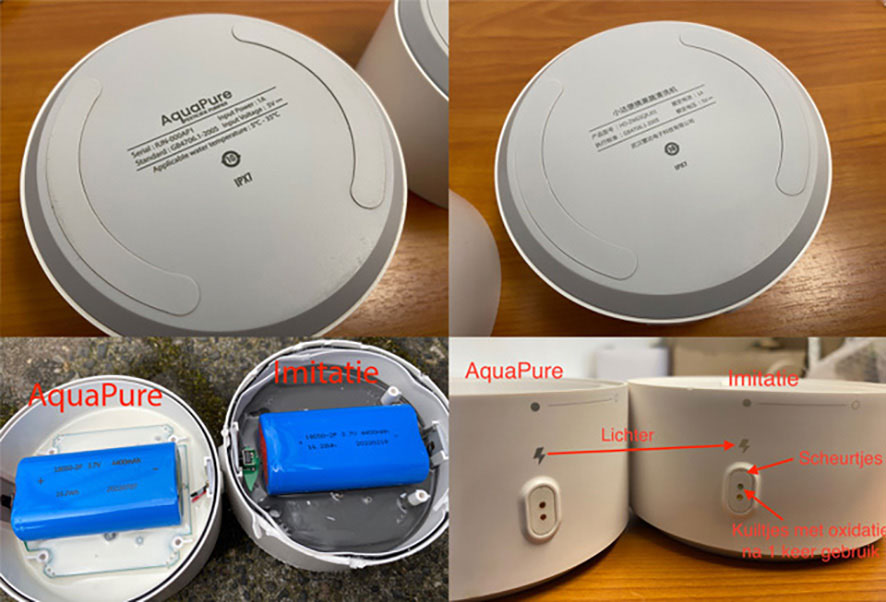
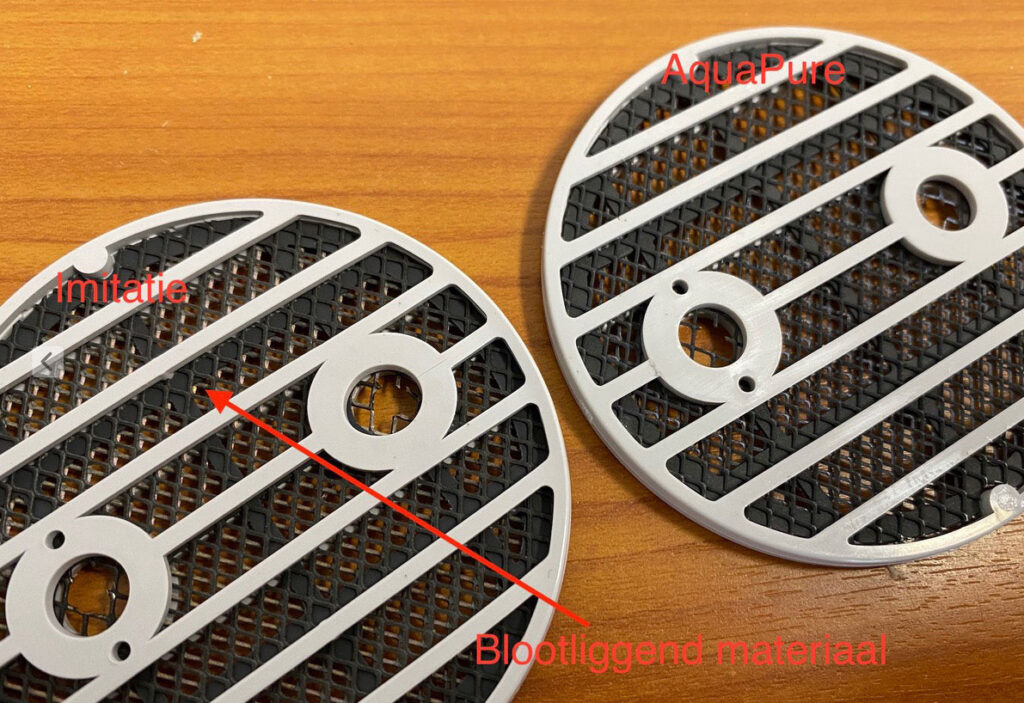
We are regularly asked whether cheap, unbranded versions or identical Chinese copies of this product are just as good. We strongly advise against this. Counterfeit devices may have stainless steel electrolysis plates, which, according to studies, can release harmful and carcinogenic chromium-6 (8). That is why the AquaPure’s cathode is made of titanium and the anode is coated with ruthenium-iridium for added safety. Although it is difficult to tell, imitation models look slightly different, particularly on the inside:

AquaPure vs imitation

It is very important to choose reliability. The AquaPure has independent test results and that is by no means certain with cheap clones.

For a smaller quantity of fruit and vegetables, one 5-minute cycle, followed by a further 5 minutes of soaking time, is sufficient. For a larger portion in a larger container, we recommend 2 cycles of 5 minutes each, followed by 5 minutes of soaking. In principle, you could now use the electrolysed water for a second portion, but AquaPure itself recommends starting again with fresh water. This way, we can be sure that there is no contamination with pesticides from the previous batch. After treatment, it is important to give your fruit and vegetables a quick rinse under the tap.

A pinch (a knife-tip) of salt in a standard container of water is sufficient. Put the salt into the container, then fill it with water. Give it a quick stir if you see any undissolved salt. Once the salt has dissolved properly in the water, the AquaPure is ready for use.

Most AquaPure units are easy to open. However, with some models, the lid can be difficult to remove, particularly if it has not been screwed on properly or if there is moisture or sand between the lid and the unit. It is therefore advisable to only open the AquaPure when it is dry. If you do need to open the lid and it is stuck, try using a fork with a plastic handle. Insert the tines of the fork into the smallest opening of a slot in the lid to remove it.

In principle, you can use the AquaPure in any container; this is usually a stainless steel sink or a plastic bowl. However, we prefer glass. IKEA sells a 28 cm glass bowl under the name TRYGG sold for just a few euros.

It’s as if this bowl were made for the AquaPure, because, as you can see, it fits perfectly on the base. It doesn’t get any cheaper or healthier than this!

The effectiveness of AquaPure has been demonstrated, amongst other things, in a Dutch laboratory research by Eurofins. This study showed that the AquaPure is able to reduce glyphosate in water by around 60% in a single cycle. A more recent study by AquaPure shows that two cycles can remove more than 95% of the glyphosate from the skin. Older studies by AquaPure also demonstrate that this device is effective. All tests were carried out in international standard laboratories with strict safety protocols. You can find all the results at this webpage from the manufacturer.

In addition, there are also many independent studies available on PubMed which show that electrolysis is capable of effectively breaking down pesticides (1, 2, 3, 4, 5, 6, 7).

You must not treat chopped vegetables and (dried) fruit with the AquaPure, not only because the vitamins and minerals will leach out, but also because these foods can absorb the electrolysed water. Electrolysed water contains aggressive free radicals that effectively break down pesticides, but which you do not want to ingest. That is why it is important to rinse your fruit and vegetables under the tap for a moment after cleaning them. Alternatively, you could also soak them briefly in a bowl of filtered water. Always allow your fruit and vegetables to dry thoroughly after washing before putting them in the fridge, otherwise they may go mouldy.

We recommend that, at the very least, you include everything from the so-called Dirty Dozen wash in the appliance. These include strawberries, nectarines, apples, grapes, peppers, cherries, peaches, pears, celery and tomatoes. For fruit and vegetables in the Clean Fifteen Or, for organic produce, a thorough rinse under the tap is sufficient. There is no point in cleaning produce with a thick skin, such as bananas, oranges, kiwis, onions, mangoes, pineapples, melons or avocados. The appliance is only suitable for whole (leafy) vegetables and fruit. It is better to peel conventional potatoes; they do not need to be treated with the AquaPure. We recommend eating organic potatoes with their skins on. You can treat these, but it is not strictly necessary if you eat them with a brush Wash them thoroughly under the tap beforehand. Mushrooms can absorb moisture, so it is advisable not to treat them. Incidentally, mushrooms are on the ‘Clean Fifteen’ list, so it is not strictly necessary to wash them thoroughly.

The AquaPure is designed to give you many years of enjoyment. To extend its lifespan, it is important to bear a few things in mind. Here are 7 important tips for using the AquaPure and ensuring the appliance has a long lifespan:

  1. Usage not too much salt, just a pinch is enough!
  2. Dry the appliance thoroughly after use and, in particular, the charging contacts, to prevent corrosion on them.
  3. Usage water that isn’t too cold, it’s best if it’s at about room temperature.
  4. You’d be better off cleaning a large amount of fruit and vegetables in one go, then just 1 or 2 pieces of fruit or veg at a time. That way, you’ll save the battery.
  5. Turn on the AquaPure not to if he not in the water is.
  6. Never store the appliance away for long periods either with a flat battery, as this may damage the battery.
  7. Clean your AquaPure regularly; see also user guide.

It’s a shame that the AquaPure isn’t working any more. There are a few steps you can try to sort out the problem and see if we can get the appliance working again.

  • If it no longer charges properly: Moisten the charging point with (organic) vinegar and leave it to soak in for a while (on a kitchen towel, stick it on and leave it for half an hour). Then scrape the charging point with a sharp knife or similar object to remove any dirt or rust (corrosion). Then recharge the AquaPure.
  • Make sure the device is fully charged. To do this, connect the device to the charger and leave it to charge for at least 5 hours. Ensure that the charger is properly connected to both the device and a power source.
  • Once the device is fully charged, you can perform a hard reset. To do this, press and hold the power button for about 10–15 seconds until the device switches off. Then release the power button and try switching the device back on.
  • If the device still won’t switch on, try connecting it to a different power source or use a different charging cable. Sometimes, faulty cables or power sources can prevent the device from charging properly.

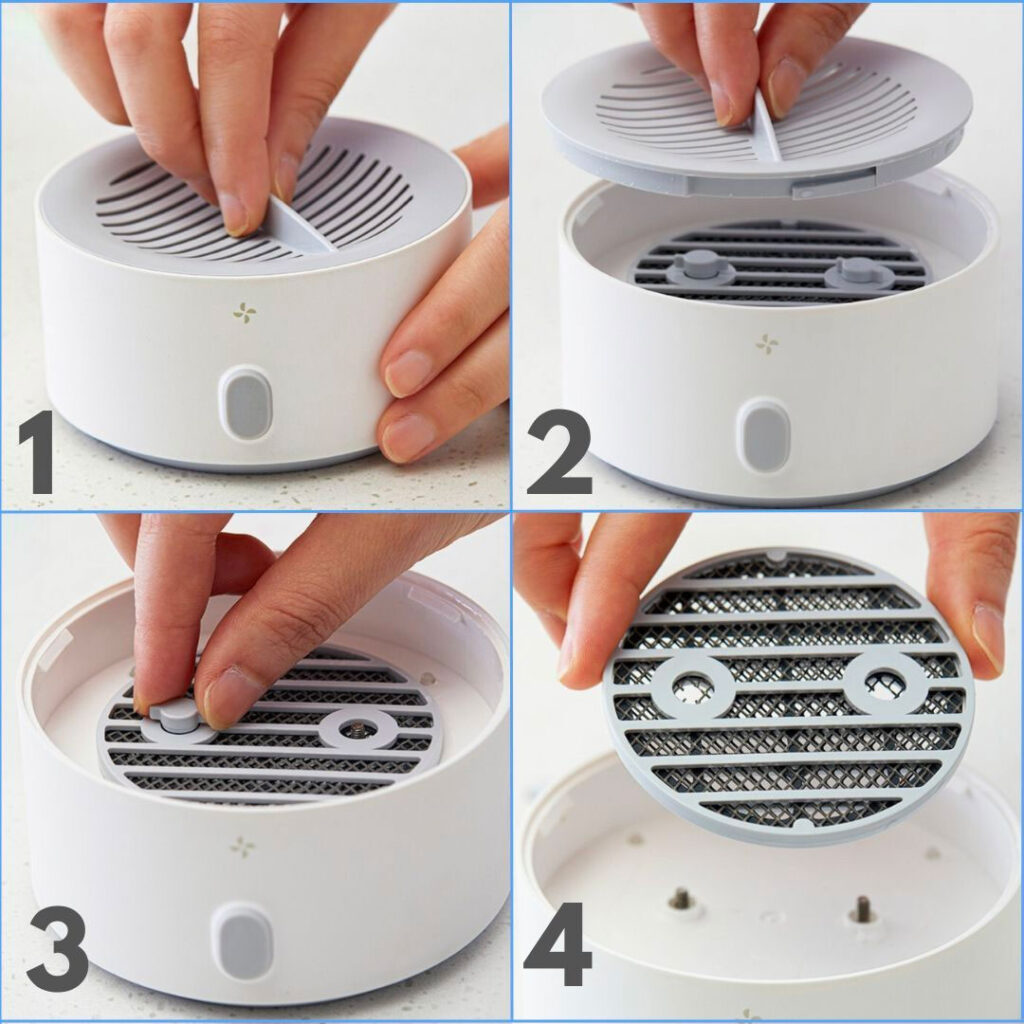
It is also possible that the parts have come slightly loose. To resolve this issue, follow the steps below:

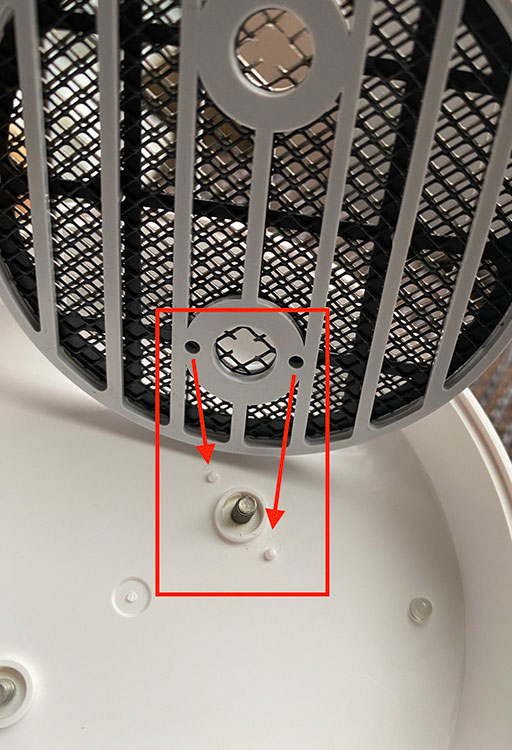
  • Unscrew the top of the appliance and you will see two screw knobs. See the image below.
  • Next, turn the two screw knobs to check that they are securely fastened.
  • Also check that the grill is fitted correctly (you’ll see two indentations on the grill and two protrusions on the appliance; they can only fit together in one way).
  • Screw the top back on and charge the AquaPure for up to 5 hours.
AquaPure Troubleshooting

If your AquaPure is still not working after following the steps outlined, we would like to receive a short video of your AquaPure unit showing the problems you are currently experiencing. We would also appreciate a photo of the underside, the side with the on/off button and the side with the charging port. You can easily send these to us via WhatsApp or else take contact Join us.

The AquaPure is made from stainless steel and ABS plastic. Acrylonitrile butadiene styrene (ABS) is a recycled plastic compound which is itself fully recyclable. ABS is also generally regarded as more sustainable, longer-lasting and easier to recycle than PVC.

Over time, the contact points may become slightly oxidised or corroded due to the effects of oxygen and water. This, in turn, can prevent a proper connection from being established with the charging cable, meaning the device will not charge. So, if the AquaPure no longer charges (the charging cable is connected, but it no longer flashes red), it is likely that there is corrosion on the contact points, which is the cause of this problem. With the AquaPure, it’s important to make sure you clean and dry it thoroughly all over after use, otherwise corrosion will form on the contact points (particularly there). This is because there is salt in the water, and the combination of water and salt – coupled with the device not being dried properly – causes corrosion on the unit. You’ll notice this mainly on the contact points and on the small grille inside.

So, just check whether you can still see a golden colour on the contact points. If there is no golden colour visible, or if it’s missing from just one of them, then there is corrosion on the contact points. To sort out the problem, you need to do the following. Dip a piece of kitchen roll in (organic) vinegar and then place (or stick) it onto the contact points so that they come into contact with the vinegar. Leave it to soak for an hour. Then rinse the device under the tap and gently scrape the contact points clean with a potato peeler. Once they’re clean again (you’ll see the golden colour reappear), try charging it once more. It should then work again as normal.

If this turns out to be the solution, then you’ll know that you need to keep the contact points clean and dry from now on. Also, don’t use too much salt, as this can be corrosive to the
The contact points are working. If this does not resolve the issue, please get in touch with us.

The manufacturer rigorously tests a wide range of different pathogens and chemicals. This takes some time, as all tests must comply with an internationally recognised standard for laboratory testing.

It has been proven that the AquaPure removes up to 99.9% of pesticides, bacteria and other harmful substances from your fruit and vegetables. All tests are carried out in laboratories that meet international standards and adhere to strict safety protocols. You can find all the results at this webpage from the manufacturer.

After daily use, or after each use, simply give your AquaPure a quick rinse under the tap. Make sure you rinse the entire unit, taking particular care to allow the water a moment to flow through the mesh filter. Then dry everything off, making sure not to forget the charging port to prevent corrosion. After that, you can turn the device upside down for a moment to let any excess water drain out from inside. You can then turn the device the right way up again and leave it to air dry. It’s important not to forget this final step, otherwise moisture and condensation will remain inside, which could shorten the lifespan of your AquaPure.

It is advisable to take the AquaPure apart once a month and give it a thorough clean by removing the lid, wing nuts and the electrolytic plate, and cleaning everything thoroughly with a cloth or small brush. You can then put it back together again. When refitting the grille, make sure you do so correctly. You can tell by the indentations and raised areas, as shown below:

Fitting the AquaPure grille

If used daily, the device should be charged every two to three weeks.

Use the magnetic charging cable that comes in your AquaPure box. Hold the cable at the right angle, close to the charging port on the AquaPure, and you’ll find it simply clicks into place! It’s as simple as that.

Under no circumstances do we recommend using the water after purification as a source of clean drinking water.

Sometimes, after cleaning, the appliance may not produce a white mist, or
is not bubbling slightly. In such cases, the electrolytic plate usually does not make good contact with the
electrolysis plate because the wing nuts have not been tightened back on completely straight. This is sometimes
Just give it a few go, but it always works in the end. After a few attempts, you’ll see that it
the device is working as normal again.

So, if you do not see any air bubbles (fizzing or bubbling) coming out of your AquaPure, switch the unit off and remove it from the water. Turn the top cover anti-clockwise to the unlocked position by turning the lever. Once the top cover has been removed, turn the nuts on the inner electrolyte components clockwise to tighten them. This should resolve the problem immediately.

If that still doesn’t work, please check that the small grid inside is positioned correctly. You can tell this by the two indentations on one side of the grid, next to a hole. These fit exactly onto the two protrusions on the appliance, on one side near the electrode. See also the image below:

Fitting the AquaPure grille

If you prefer to wash all your fruit and vegetables at the same time, we recommend running several wash cycles.

Our recommendations for optimal cleaning results are as follows:

1 to 3 litres of water: One cleaning cycle
4 to 6 litres of water: Two cleaning cycles
7 litres of water or more: Three cleaning cycles

To start a new cycle, simply click the ON button again. To improve cleaning efficiency, we recommend adding a pinch of salt.

Yes, the AquaPure is phthalate-free, contains no traces of PVC and is completely BPA/BPS-free.

Absolutely! But make sure you give your sink a thorough clean beforehand to achieve the best possible results.

After daily use, or after each use, simply give your AquaPure a quick rinse under the tap. Make sure you rinse the entire unit, taking particular care to allow the water a moment to flow through the mesh filter. Then dry everything off, making sure not to forget the charging port to prevent corrosion. After that, you can turn the device upside down for a moment to let any excess water drain out from inside. You can then turn the device the right way up again and leave it to air dry. It is important not to forget this final step, otherwise moisture and condensation will remain, which can shorten the lifespan of your AquaPure. It is advisable to take the AquaPure apart once a month and give it a thorough clean by removing the lid, wing nuts and the electrolytic plate, and cleaning everything thoroughly with a cloth or small brush. You can then put it back together again. When refitting the grille, make sure you do so correctly. You can tell by the indentations and raised areas, as shown below:

Fitting the AquaPure grille

100 x 50 millimetres / 3.94 x 1.97 inches

The charging cable supplied has a USB connector. This means you can charge your AquaPure using any USB plug (not USB-C) you have at home. A phone charger, for example!

Yes, the magnetic charging cable is included in the box. It’s tucked away quite well, though, as it’s in the false bottom of the box. PLEASE NOTE! There’s no plug included, but it’s just a standard USB plug, which everyone tends to have lying around at home these days.

Yes, every AquaPure comes with a 2-year warranty.

The AquaPure is a one-off investment designed to last. There are no expensive filters or other parts that need replacing.

Yes, this one is available and you can Download here.

Frequently Asked Questions about Moon Flow Tea

Moon Flow and Baby Flow tea

You can start drinking the tea on any day of the month. Choose the right tea depending on your symptoms and where you are in your cycle. If you’re only drinking Baby Flow, or only Moon Flow, it doesn’t matter when you start. If you’re drinking both, then check our webpage on usage (or below) to find out which tea is best to start with.

When should you drink which Moon Flow tea?

Please note:

Do you only drink Moon Flow tea –> Have a cup of this, starting from the second half of your cycle at the very least. Do you suffer from very severe symptoms, or do you have PCOS or endometriosis? If so, have one or two cups of tea every day.

Do you only drink Baby Flow tea –> Drink this from the start of your period right through to ovulation.

Mom Flow tea

Are you pregnant or have you just had a baby? Congratulations! What a special and exciting time lies ahead for you. Especially for all (expectant) mums, the Mom Flow tea range developed. Check our webpage on usage (or below) to find out which tea is best to start with.

We recommend drinking at least 1 or 2 cups a day. You can always have more!

It’s simple: just make sure you have a good stainless steel filter or, alternatively, disposable filters. Then spoon two teaspoons of your chosen tea into the filter and pour the hot water over it. You can, of course, use a measuring spoon as well.

Due to the presence of lady’s mantle and raspberry leaves, it is recommended that you do not drink this during pregnancy. You may resume drinking it from week 38 onwards. Are you pregnant? If so, please also check the Mom Flow herbal tea for during and after pregnancy. They are safe to drink.

Moon Flow tea
This tea is available in three varieties, Original, Tropical Summer and the Winter edition. All the flavours are mild and subtle – so no unpleasant spices! The Tropical Summer variety has some extra dried fruit added, which makes it a little sweeter. The Winter edition features spices such as cinnamon, cardamom and ginger!

Baby Flow
The taste of the Baby Flow It’s a bit fresher than the Moon Flow tea. This is mainly due to the small amount of peppermint. And don’t worry – even if you’re not a fan of peppermint, you’ll still love this flavour. Because it’s quite subtle.

The herbs in the tea also have a diuretic effect. This may mean you need to go to the loo a bit more often at first. Nothing to worry about!

No, you buy the tea as loose herbal tea in 75-gram sachets. So it’s a good idea to get yourself a tea strainer so you can brew the tea. We always recommend a larger infuser rather than a tea strainer or tea egg, as tea leaves and herbs often expand slightly in the water and need space to release their full flavour.

Ingredients: Moon Flow Original tea

Lady’s mantle, raspberry leaf, orange peel, fennel, stinging nettle, lemon balm, lemongrass, sunflower blossom

Ingredients Moon Flow Tropical Summer tea

Lady’s mantle, raspberry leaf, orange peel, fennel, stinging nettle, lemon balm, lemongrass, sunflower blossom, pineapple, apple, orange slices, strawberry, safflower petals, natural flavouring, marigold petals

Ingredients Moon Flow Winter tea

Lady’s mantle, raspberry leaf, orange peel, fennel, stinging nettle, lemon balm, lemongrass, sunflower blossom, cinnamon, star anise, ginger, cardamom, cloves

Ingredients Baby Flow tea

Lady’s mantle, raspberry leaf, lemon balm, stinging nettle, passion flower, red clover, ginger, angelica, black cohosh, goji berries, peppermint, pomegranate

Ingredients: Mom Flow Mom’s Delight tea

Stinging nettle, oat straw, lemon balm, ginger, camomile, rosehip

Ingredients: Mom Flow Mom’s Nourish tea

Stinging nettle, verbena, lemongrass, raspberry leaf, galega (goat’s rue), blessed thistle, hibiscus, rosehip, rose petals, marshmallow leaf

Ingredients in Mom Flow Little Tummy Care tea

Honeybush, caraway, aniseed, fennel, nettle, camomile

Frequently Asked Questions: MLS washing magnets

As well as having many satisfied customers worldwide, MLS Wasmagneten were tested by an independent laboratory right from the very start. Click below to view one of the independent laboratory test reports from one of the world’s largest testing organisations:

It confirms that the MLS Wasmagneten do indeed clean garments and do not damage the colours or the tensile strength of your clothes. The technology behind the MLS Wasmagneten is also protected by two patents.

The MLS Laundry Magnets (washing without detergent) are completely different from anything you’ve ever seen or heard of before. They aren’t even really referred to as laundry balls, because this is such a unique process and technology. This is a twice-patented technology based on utilising permanent magnetic force to support the washing process. Most “laundry ball” products are usually small chemical pellets contained within a ventilated, round plastic sphere. These chemical pellets run out after a number of washes and then need to be refilled. From an environmental point of view, it is still slightly better than washing powder, but the process remains chemical (similar to washing powders) and is therefore completely different from the MLS Washing Magnets.

First of all, you need to know that you don’t wash your clothes with soap – and you’ve probably never done so in your life. Detergents are not soap. They are petrochemicals derived from crude oil. Water is the universal solvent. Water is what ultimately cleans your clothes, whether you use detergents or MLS Laundry Magnets. All these products help water to clean more effectively. MLS Laundry Magnets do so on a chemical-free, fully renewable magnetic basis, whilst detergents rely on non-renewable petrochemicals. Magnetic force is one of the most powerful forces of nature on Earth. In fact, the Earth itself is a giant magnet with a north and south pole. It is a tremendous source of natural energy. Even the weak magnets on your fridge defy gravity without batteries or being connected to a power source. MLS Laundry Magnets simply harness that amazing power and concentrate it in your washing machine at home to influence the water. At the atomic level, everything is affected by magnetism. All you need to do is try it for yourself and see the results with your own eyes. So yes, you can do your washing without detergent!

This seems to be a certainty. Detergents are chemical surfactants derived from crude oil. With one exception, the basic building blocks of surfactants are all derived from crude oil. Unless detergent manufacturers choose to reduce their profit margins to keep the cost of detergent low, you will pay more and more for detergent, just as you pay more and more to fill up your car with fuel. As the cost of raw materials for detergent rises, so too do the costs for end users. Furthermore, their plastic containers (which are made from just 25% recycled plastic) are made from petrochemicals, and shipping these bulky and heavy bottles costs more due to record-high fuel prices. These additional costs are ultimately passed on to the end user as well.

Optical brighteners are only effective if they remain on the fabric after washing, meaning they are constantly inhaled and come into contact with and are absorbed by your skin. Clothes washed in detergents containing these agents leave a potentially harmful chemical residue on the fabric. Skin rashes often attributed to fragrances and colourants are frequently caused by optical brighteners; therefore, optical brighteners should not be used by people with sensitive skin.

Optical brighteners contain chemicals that can be toxic to fish, other animals and plants. Many have also been shown to cause mutations in bacteria (seventhgeneration.com). Furthermore, these chemicals are not readily biodegradable, meaning the pollution remains in the wastewater for a long time, which has a negative impact on water quality and on the lives of animals and plants. So, when you’re at the supermarket, you might want to avoid comments such as: “Brings out the colours! Whiter white!”, given the concerns about what you’re actually getting.

That depends on your definition of “clean” and “bright”. When comparing the use of MLS Laundry Magnets (washing without detergent) with detergent, there are a few things to bear in mind. Firstly, detergents are not soap. They are chemical surfactants derived directly from crude oil, and these chemicals are designed so that they are not completely rinsed out after washing your clothes. They leave behind so-called “optical brighteners” – synthetic chemicals that reflect more light off the clothes to make them look “brighter” to the eye. We do not believe that adding what are essentially chemical mirrors to a garment makes it any cleaner. These synthetic chemicals convert UV light wavelengths into visible light, making washed clothes look whiter (although this has no effect on the cleanliness of the clothes). They have been found to be toxic to fish and to cause bacterial mutations. Furthermore, they can cause allergic reactions when they come into contact with skin that is subsequently exposed to sunlight.

As these chemicals have the potential to cause health problems and may lead to environmental issues, we believe that their presence on clothing seriously compromises its cleanliness. Most people are not even aware that potentially harmful petrochemicals derived from crude oil are constantly present on their clothing, which may cause skin and respiratory problems for the wearer. We define ‘clean’ as free from chemicals, harmless to the wearer and non-toxic to the environment, as well as being visually acceptable. But only you, the user of the product, can determine that. We feel that there are many people, just like us, who do not want to walk around all day with petrochemicals and optical brighteners in their clothes.

Absolutely. We simply recommend that, if you have a front-loading washing machine, you place the MLS Laundry Magnets in a pair of socks or trouser pockets before starting the wash cycle. This eliminates any noise that the force of the horizontal axis might cause. And whilst magnetic force should not come into direct contact with electronics, the magnets are used inside the drum and are positioned far enough away that, when used correctly, they will not affect the electronic controls. Just make sure they do not rest on the electronic control panel. Furthermore, the two magnets together weigh only a fraction of a pair of wet jeans. So you needn’t worry about any significant extra weight.

This isn’t a problem and doesn’t affect their cleaning power. If you want to keep them separate, you could, for example, put them in different trouser pockets (which you’ll be washing) to keep them apart.

The most obvious and important fact is that using MLS Laundry Magnets, rather than detergents, prevents petrochemicals from being discharged into our water supply. This helps to preserve our most valuable natural resource (water), which is crucial to human survival. Less than 1% of the world’s water supply is considered drinkable, and preserving the quality of this irreplaceable resource is of the utmost importance for the survival of humans, animals and plants. Furthermore, bypassing the rinse cycle can save a huge amount of additional water (20–40 litres per wash), electricity (mainly generated by burning coal and oil, which are major polluters), natural gas (for heating the extra water) and sewage treatment. It may also help to reduce the causes of global warming – given that such a vast quantity of detergents is produced and used worldwide, considerable resources (fossil fuels) are consumed in their production and distribution.

There are many benefits. The most important thing is that if you or your family suffer from washing powder-related symptoms, such as skin problems and/or breathing difficulties, you owe it to your health to switch to a non-chemical alternative.

From a financial point of view, you should be able to save hundreds of euros a year on washing powder. You could save even more if you skip the rinse cycle, as it is no longer necessary (which would also save 20 to 40 litres of water per wash, which is good for the environment).

You’ll save time, reduce the effort involved in doing your laundry and avoid having to lug black bottles or packs of washing powder home from the shop every time. Your wardrobe (which is a considerable investment) can last much longer thanks to the reduction in harsh chemicals. It makes your home “greener” and also more child-friendly by reducing the amount of toxins in your home.

It can have a huge impact on the environment by reducing the use of chemicals and our reliance on imported petrochemicals (Yes, detergents are petrochemicals derived from crude oil).

Etc., etc.

Generally speaking, warmer water always ensures the cleanest clothes, whether you use MLS Washing Magnets or washing powder. Just think about when you’re washing up in the sink. Cold water will clean off stuck-on food, but hot water will remove it more quickly and efficiently, using less water. It’s exactly the same in your washing machine.

However, for certain items of clothing and fabrics, you may need to use lower temperatures, and you can simply continue to do so. Many customers report excellent results by using only cold water with the MLS Laundry Magnets. For the reason outlined above, we still recommend that users use warm water, but ultimately you are free to test the product in different ways and choose the option that best suits your personal situation.

Using cold water is clearly better for the environment (lower energy consumption), but bear in mind that the astonishing health and environmental benefits of preventing petrochemical detergents from entering the water supply and coming into contact with our skin are of far greater importance. Nevertheless, the MLS Laundry Magnets leave virtually no ecological footprint when used with cold water.

The MLS Laundry Magnets (washing without detergent) have been designed and developed to last for decades and save you thousands of euros, as you will no longer need to buy detergent. Over the years, you’ll also prevent thousands of kilos of chemicals from entering our water supply and stop your clothes from being saturated with perfume. This also has a positive effect on your health and that of your family.

No fragrance is added when using the MLS Laundry Magnets. The truth is that clean clothes don’t smell of anything. They don’t smell of perfume. And most people go way overboard with these scents. They use washing powders, stain removers and bleach containing perfumes in their washing machine. Then they use fabric softeners and/or tumble dryer sheets in the tumble dryer, which add even more perfumes. They also wash their bodies with perfumed soap and shampoo and dry off with their perfumed towel (after having slept all night in perfumed sheets and pillowcases). They then apply perfumed deodorant and spray on their favourite perfume. This is simply too many chemicals on the body, and sometimes the body rebels with skin rashes, breathing difficulties or illness.

If you absolutely cannot live without a bit of fragrance on your clothes, just use one scented tumble dryer sheet. There’s simply no reason to pile all those other scented chemicals onto your clothes. And you should be aware that most of them are very harmful to your skin and respiratory system, so the less you use, the better off you’ll be. Some symptoms, such as red eyes, rashes and runny noses, aren’t caused by allergies, but by the perfume and petrochemicals left behind on your clothes.

Yes. To be honest, nothing makes things as white as chlorine bleach, but there are few chemicals that are more toxic to the environment and to health. Bleach is very harsh and can also damage your clothes. That said, if you’re not put off by these considerations, you can still use diluted bleach with the MLS Laundry Magnets (washing without detergent) if you wish. A good alternative to chlorine bleach is oxygen bleach. Borax is also an excellent natural laundry booster. Some users of the MLS Laundry Magnets add bicarbonate of soda or white vinegar to their wash.

Once again, MLS Laundry Magnets are merely an alternative to washing powder. Washing powder is not used to kill micro-organisms, and neither are MLS Laundry Magnets. The washing process itself rinses away most bacteria. However, hot water will kill most microorganisms in the water, and a little bleach will do the same (although bleach works best at high temperatures, so that’s a bit of a waste).

* A highly effective natural alternative: Numerous studies show that a pure 5 per cent solution of vinegar (such as that available in supermarkets) kills 99% of bacteria, 82% of fungi and 80% of pathogens (viruses).

MLS laundry magnets are simply an alternative to washing powder. Just as with washing powder, separate products used for other purposes must be used on their own. These include stain removers and bleaches. These are used separately from the MLS Laundry Magnets, just as they are used separately from washing powder.

The MLS Washing Magnets (washing without detergent) do not need to “stick” to the washing drum at all to work properly. There is a wide variety of washing machines, from front-loading to top-loading models, and inner drums made from materials ranging from plastic to iron and stainless steel. The material the drum is made of doesn’t matter; the MLS Laundry Magnets (detergent-free washing) work in all of them. The magnets may “stick” together during the wash cycle. This is perfectly normal and will not reduce their effectiveness, as they still emit the same level of magnetic force, whether they are attracted to one another or not. The laundry magnets simply need to be submerged and/or placed close to the water for maximum effectiveness.

Frequently Asked Questions: Mayu Swirl

Yes! We recommend this one: Natural Care Company Electrolytes.

Enjoy the beauty of uniqueness! Every MAYU Swirl base is handcrafted, making it as unique as a snowflake. This individuality ensures that no two bases are identical, so you’ll receive a one-of-a-kind piece that adds a touch of exclusive charm to your Swirl experience.

To maintain the carafe and the impeller (white fan) of your MAYU Swirl properly, you should clean them daily (or at least every other day) with washing-up liquid if you use them every day, to prevent limescale build-up on the impeller (the white disc in the carafe). This is particularly important if you use tap water or mineral water, or if you add anything to your water whilst swirling (minerals, fruit or other ingredients). If you’re swirling wine or juice, you must clean the carafe and impeller after every use.

The MAYU Swirl carafe is watertight and dishwasher-safe. If, after regular use, you notice limescale build-up – whether washed by hand or in the dishwasher – don’t panic! Add a teaspoon of citric acid or vinegar to the carafe and fill it with warm water. Place the carafe on your MAYU Swirl base and let it spin until there is no more limescale visible on the sides of the carafe. Empty the carafe and wash it.

We do not recommend putting the impeller in the dishwasher. Instead, wash it by hand. To remove stains from the impeller, add a cup of water and a tablespoon of bleach (or chlorine-free bleach). Leave it to soak overnight, then rinse off any bleach residue and wash it thoroughly with soap and water.

If you have a carafe where the impeller is attached to the base, you can use something like this: https://www.amazon.nl/-/en/Flexible-gripper-reacher-removal-bendable/dp/B07Y75N3DW?th=1 to remove the impeller, clean it and put it back into the carafe.

If your brand-new MAYU Swirl isn’t creating that enchanting swirl (vortex), don’t worry! You’re now the proud owner of the latest version, featuring a redesigned carafe. You probably haven’t forgotten anything. Inside, you’ll find a small white disc – the impeller – carefully wrapped in tissue paper and placed on the spout.

Unleashing the magic is child’s play! Remove the filter paper, take the spout off the carafe, gently slide the little fan into the water in your carafe, put the spout back on and voilà! Let the swirling begin and enjoy the enchanting spectacle, just as you imagined it. Get ready for the magic!

No, if the glass of the carafe breaks whilst in use, this is down to your own actions. We know that accidents happen. That’s why we also sell the carafe separately, so you don’t have to buy a whole new MAYU Swirl. You can find it here: /products/mayu-swirl-carafe/.

The MAYU Swirl comes with a 2-year statutory warranty. This covers all faults resulting from manufacturing defects. You also benefit from a quality assurance scheme, which guarantees a durable and reliable product.

Thank you for purchasing the MAYU Swirl! This innovative device transforms your tap water into revitalised, oxygen-rich water. Follow these steps to install and use your MAYU Swirl correctly:

Contents of the box:

  • Porcelain base
  • USB charging cable
  • USB adapter
  • Glass carafe made from borosilicate glass
  • Stainless steel spout
  • White impeller

First steps:

  1. Prepare the base:
    • Connect the USB cable to the adapter and plug it into a socket.
    • Plug the other end of the cable into the USB-C port on the back of the porcelain base.
    • The charging indicator light glows orange and turns white once charging is complete. A fully charged Swirl can be used wirelessly for up to 6 hours.
  2. Prepare the carafe:
    • Clean the glass carafe thoroughly with warm water and washing-up liquid, then rinse it well.
    • Remove the white fan from its protective paper and carefully slide it into the carafe.
    • Fill the carafe with up to 1.5 litres of drinking water.
  3. Commissioning:
    • Place the filled carafe in the centre of the porcelain base.
    • Gently touch the touch sensor at the bottom to start the 'swirl'.
    • Allow the water to circulate for at least 7 minutes to maximise oxygen uptake and to fully aerate it.

Comments:

  • Make sure the impeller (white blade) lies freely on the bottom of the carafe to ensure optimal swirling.
  • If you wish, after 'swirling' you can' minerals Add to the water. Please refer to the dosage recommendations on the packaging of the minerals.
  • Clean the carafe regularly to maintain water quality.

For a visual guide to getting started and using your MAYU Swirl, we recommend our instructional videos on.

Please feel free to contact Please get in touch with us if you have any further questions. 

Enjoy your refreshing water and make sure you stay well hydrated!

Borosilicate glass is considered the best material for a carafe, as it is highly durable, heat-resistant and does not react with water. This makes it the ideal choice for safely storing and serving water, whilst preserving its natural flavour and purity.

Yes, a borosilicate glass carafe is perfect for both hot and cold water. The glass is designed to withstand extreme temperature changes, so you can safely use it for both hot tea and cold drinks without worrying about it breaking.

A Class A borosilicate glass carafe is made from the highest quality glass, which is resistant to chemical reactions and the release of harmful substances. This ensures that no harmful substances end up in your water. As a result, your water remains pure and uncontaminated.

Unlike traditional glass carafes, a borosilicate glass carafe is extremely resistant to temperature fluctuations and chemical reactions. This means that it can withstand temperature fluctuations without cracking, and that the taste or quality of the water inside is not affected.

A handmade carafe, crafted with care, offers superior quality and aesthetics compared to mass-produced items. The MAYU Swirl carafe, made from 100% borosilicate glass, ensures that your water is stored in a safe, chemical-free environment, which benefits both its taste and its health benefits.

A borosilicate glass carafe is a high-quality option for storing and serving water. Thanks to its heat resistance and durability, it is the ideal choice for preserving the freshness and purity of the water whilst preventing the release of chemicals.

www.alternatievemiddelen.nl’s rating at WebwinkelKeur Reviews is 4.9/5 based on 1,899 reviews.